There was a time when search meant Google. You typed a phrase, skimmed a few blue links, maybe clicked one.
However, that rhythm is breaking, and it’s not just another search engine that’s threatening to replace it. This change isn’t cosmetic. It transforms how content is discovered, what it needs to do, and who it’s really for. If visibility once depended on pleasing algorithms, now it depends on being a substantial part of a conversation.
What follows is not just a glossary of new tactics addressing SEO for large language models (LLMs), but a clear-eyed look at how search is evolving and what it takes to stay visible when the results page has no page at all.
KEY TAKEAWAYS: THE LLM SEARCH SHIFT
• The New Currency: Success is no longer measured in clicks alone, but in citations and being part of the conversation.
• Dual Optimization: You must now satisfy two different behaviors—Google’s technical crawling and the LLM’s training-set memory.
• Quality over Volume: Thin content is a liability. Topical depth and factual consistency are the only ways to remain visible.
• Consistency is Key: LLMs trust messages that are repeated and verified across multiple credible sources.
What SEO for LLMS Means Today
SEO for LLMS is about making your content part of the answers people get when they ask tools like ChatGPT or Claude for advice, explanations, definitions, or recommendations.
These systems don’t create a ranked list of links. They generate responses based on everything they’ve read and recognized as reliable.
But it’s not sufficient for your content to exist to appear. AI will only include it if it’s clear and consistently reliable.
This isn’t traditional SEO with its formulas and checklists. Make it your objective to write in a way that models can understand and trust, even without seeing your name on page one of Google.
When it comes to LLMS, you can’t strive to get clicked because being quoted is what matters.
Forget about shaping your content solely based on keywords and aim for authority, and how your information fits into a broader web of knowledge. In a nutshell, if AI is answering the question, you want your words in its mouth.
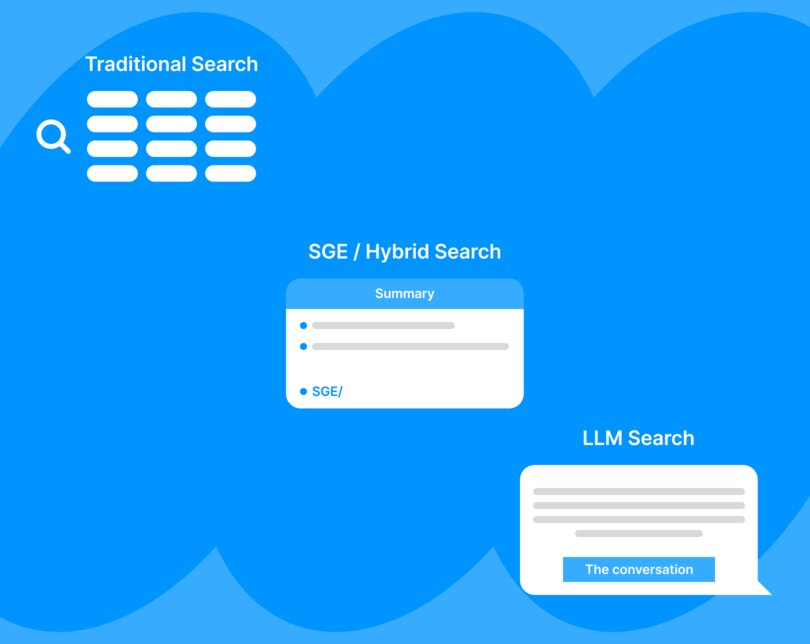
Traditional SEO is Still the King (for Now)
Most online content still lives or dies by how well it performs in Google. That hasn’t changed and probably won’t for a while.
After all, nearly 8 out of 10 desktop searches worldwide still ran through Google in 2025. So, if you want to be discovered and seen, this search engine is your best bet.
The algorithm still depends on a combo of technical cues and content quality, with a strong focus on whether your page matches the user’s intent.
Trust remains the other highly coveted element. It’s not just about what you say. What genuinely counts is whether other trusted sources point to you as well.
It shouldn’t surprise you that trust signals like EEAT and strong backlinks aren’t sitting on the margins yet. Search engines continue to use them to figure out which sources deserve attention.
Language models don’t rank websites the way search engines do. They pull from patterns, familiar sources, and what they’ve seen enough times to trust.
If your content keeps appearing in those places, it doesn’t disappear; it simply works in quieter ways. As SEO trends shift, your efforts don’t vanish. They resurface in responses, summaries, and suggestions, even if no one clicks a link to get there.
When Users Ask ChatGPT: A New Kind of Ranking
By now, you’ve probably asked ChatGPT something instead of Googling it — maybe once, maybe ten times today. You ask a question, and instead of scrolling through a bunch of links, you get a straight answer. Sometimes it comes with sources, especially if ChatGPT is set to search the web. Other times, it doesn’t, relying only on what it already “knows.”
Either way, the answer usually feels clear enough that you don’t bother looking anywhere else. That’s the shift behind ChatGPT search.
There’s no ranking to check, no clicks to count, but there is still exposure. And for marketers, that exposure depends on whether the model sees your content as worth naming.
Citation is the new currency. If your brand shows up clearly and consistently in places the model pulls from, your chances of being credited go up.
That’s what SEO for ChatGPT is really about. It’s making sure your content isn’t just out there, but that it’s showing up when the answers are written.
Content Strategy That Appeals to LLMs
Perhaps you’re among those professionals who’ve spent the last decade tailoring every paragraph around keywords and schema markup, so switching gears for LLMs might feel like losing the plot. But here’s the silver lining: the goal isn’t to unlearn everything.
However, you should recognize that you’re now writing for two systems that behave very differently. One wants to crawl your site and rank it. The other wants to absorb your content and decide if it’s useful enough to mention in a conversation.
The way LLMs evaluate content is less about structure and more about how often and where your message shows up. What powers their answers isn’t crawling your site in real time, but a mix of previously trained data and whatever they can access live through browsing tools or plugins.
So, if your content isn’t showing up across multiple trusted sources (and saying the same thing every time), it probably isn’t sticking.
Authoritative tone helps, but coherence matters just as much. LLMs aren’t impressed by filler, vague claims, or jargon you tossed in to sound smart. The content that tends to surface is clear, complete, and factually consistent.
In other words, you must ditch old SEO myths about keyword stuffing and think more like a teacher than a traffic-chaser.
ChatGPT vs. Google
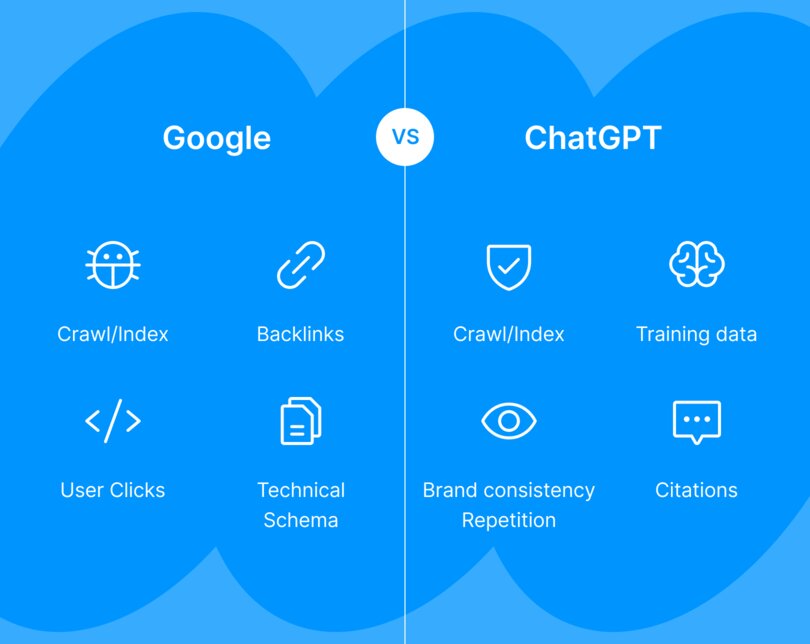
Each system looks for different things, and your strategy should acknowledge this:
- Google likes technical structure. Clear hierarchy, headers, links, and proper schema help it figure out what your page is about.
- ChatGPT looks for repetition and consistency. It notices when your content shows up across different sources, saying the same thing, clearly and confidently.
- Google tracks behavior. Time on page, bounce rate, and link profiles all feed into ranking.
- ChatGPT doesn’t care who clicked. It remembers what it’s seen often enough to trust.
But the good news is that you’re not optimizing (only) for robots anymore. You’re optimizing to be remembered.
ChatGPT and SGE in SEO: Know the Difference
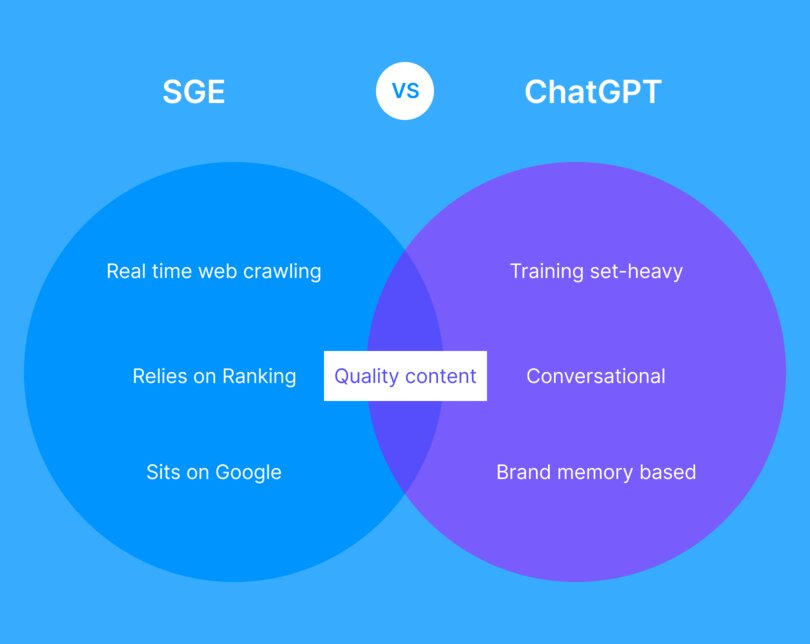
A lot of marketers are treating ChatGPT and Google’s new AI features like they belong in the same bucket. They don’t.
Both use large language models to generate answers, but how they decide what to include (and how they surface your content) couldn’t be more different.
ChatGPT doesn’t crawl the internet. Unless it’s running in a mode that allows web access, it’s working off whatever it saw during training.
That means your newest blog post, campaign, or product page might not exist to it at all, unless it’s been quoted, linked, or published on sites that were part of the model’s data.
Getting cited isn’t random, but it’s not always obvious either. You’re playing a long game based on presence and repetition.
SGE works differently. It still uses AI, but it sits on top of Google’s traditional system.
Your site still has to be indexed. Your content still needs to rank. The twist is that now, Google’s model tries to answer questions directly inside the results page, pulling from top-ranked sources in real time. If your site shows up there, it gets cited. If it doesn’t, the AI summary moves on without you.
What is SGE in SEO
Search Generative Experience (SGE) is Google’s way of injecting AI answers into its search results without abandoning the mechanics of search itself. It’s not replacing rankings, but it is repackaging them.
Here’s what that means for SEO:
- Your content must be live, crawlable, and indexed.
- Ranking well still matters, maybe even more now.
- The AI summary draws from content Google already trusts.
- Citations are usually shown and can drive traffic.
- Everything you already do for SEO — structure, clarity, EEAT — still applies.
So, while SGE in SEO doesn’t blow up the game plan, it does reward content that’s not just technically solid but also easy to lift into an instant answer. ChatGPT, by contrast, doesn’t care how tidy your code is or when you published it.
It cares whether your message appears often enough (and consistently enough) to stick in the model’s memory. Different goals. Different tactics. You need to plan for both.
Practical Techniques to Rank in Both Systems
Here’s how to start building content that Google and LLMs pick up without resorting to outmoded and formulaic tricks.
1. Start with Clear, Structured Content
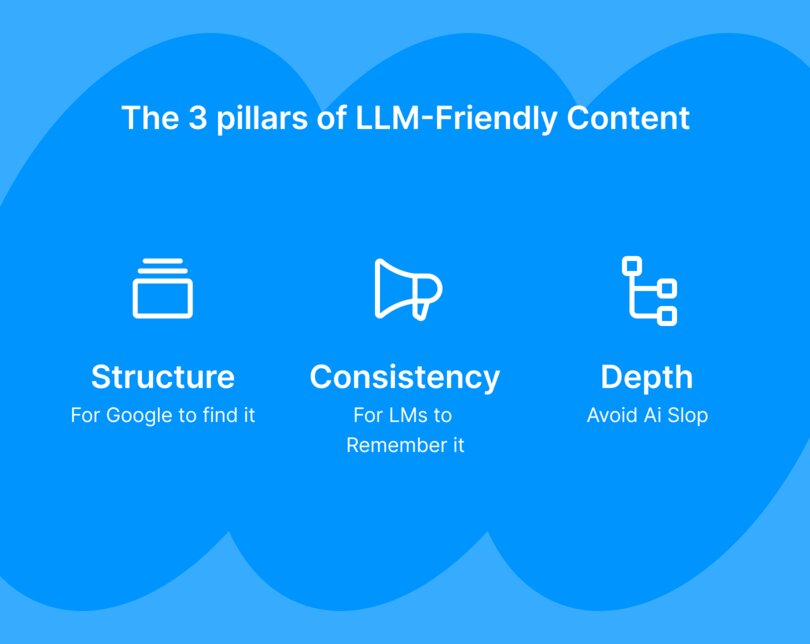
Ranking on Google still begins with structure. Use unambiguous headings that reflect what the page covers. Break up dense paragraphs. Guide readers with internal links that make sense. Clean layout helps, but the real value lies in making the content easy to follow, not just for humans but also for crawlers.
Schema markup is worth your time, especially for reviews, how-tos, and product pages. Use FAQPage, HowTo, and Product where it applies, as this can help your content get pulled into both SGE and AI summaries. Also, check your sitemap and make sure important pages aren’t buried five clicks deep.
2. Write Like You’re Being Quoted
Language models don’t care how pretty your layout is. They surface what they’ve seen repeated across the web in a way that sounds authoritative and stable.
That means your content needs to sound accurate and honest, not salesy or vague. Keep the same essence everywhere, and by “everywhere,” we really mean it: your blog, in your product descriptions, in bios, even in third-party reviews.
Don’t try to be an omnipresent detective and use all the available tools (e.g., BrandMentions, Semrush) instead to make tracking of websites and media citing or paraphrasing your content easier. LLMs are more likely to carry your message into the conversation if it appears in various credible domains.
3. Stop Publishing Content That Says Nothing
Filling space with fluff doesn’t work anymore. Google’s AI Overviews are already skipping thin content, and LLMs are even less tolerant. If your page says what ten other sites have already said, and says it worse, expect to be ignored.
To rank in both spaces, you need real depth. Build topic clusters instead of random one-offs. Add internal links. Answer questions no one else is bothering with. Don’t write to publish. Write to explain something well. That’s what earns trust from both systems.
4. Think About Both Systems (Always)
SGE and SEO aren’t separate tracks. They are two filters applied to the same content. One might reward structure, the other repetition. One likes schema, the other favors clarity. Both ignore garbage.
You’re not optimizing for bots. You’re building something coherent enough for a person to understand and familiar enough for a machine to repeat without butchering it. That is the bar now. And, if we’re being honest, it’s higher than it used to be, but that should encourage you to create even more remarkable content.
Where SEO for LLMs Is Headed Next
Search engines and AI assistants used to serve different purposes. One handed you a list of options to sort through. The other tried to give you the answer upfront.
Now, they’re starting to blend, and that’s where things get interesting. Google’s AI Overviews already pull information into summaries before anyone clicks a link. ChatGPT’s newer tools can browse, cite sources, and sound a lot like a search engine with opinions.
The gap is closing.
So, where does that leave content folks? SEO for LLMs isn’t going to be some side project much longer because it’s quickly becoming part of the main job if you want people (or machines) to find you at all.
If LLMs begin to cite more frequently and reliably (and some are already moving in that direction), the value of being quotable, not just rankable, will skyrocket.
And then there’s the looming question: Is AI content bad for SEO? Not inherently. But if everyone starts flooding the internet with generic, AI-written content, models will learn from that too, and they’ll get worse and really turn into what many people accuse artificially generated content of: AI slop.
The better bet is to write something someone might actually quote. Use your own tone and style. Say something authentic. Skip the filler. If that’s your default, you’re already ahead of the crowd shoveling out fluff by the paragraph.
Final Thoughts
Most SEO strategies still aim to please Google. That’s fine, but it’s no longer enough.
AI tools like ChatGPT are restructuring how people find information and content and decide which one to trust, often without ever clicking a link. You can’t be torn between adapting to this change or waiting to see how it turns out. SEO for LLMS asks different questions, rewards different signals, and plays by rules traditional tactics don’t always cover.
It’s worth taking a serious look at how your content holds up across both search engines and AI prompts. For brands that are in a delicate process of rethinking their strategy, working with professionals providing SEO services that understand both worlds is the right start.