Large language models, generative AI, artificial general intelligence, workflow orchestration tools, the arrival of ChatGPT-5... you might think you've finally wrapped your head around AI.
Now, along comes agentic AI, and it’s understandable if you’re on the verge of a mental short circuit trying to keep pace with the tech buzzwords of the 2020s. That’s exactly why drawing a clear line between these terms matters more than ever.
NVIDIA’s CEO, Jensen Huang, has already declared 2025 “the year of AI agents,” so knowing what sets them apart could give you a strategic edge. The encouraging news? It’s not as complicated as it sounds, once you know where to look.
In this piece, we’ll break down the agentic AI vs. generative AI and how they differ in capabilities, as well as what that means for you and your business.
What Is Agentic vs Generative AI and Why People Get It Wrong
Agentic AI vs generative AI rests on intent and execution. Generative AI is prompt-driven and content-focused. Ask for text, image, translation, or code, and it returns content, no follow-through.
But agentic AI is autonomous and goal-driven, meaning it accepts objectives, plans, decides, and acts across systems without human input.
Here’s what that means in practice.
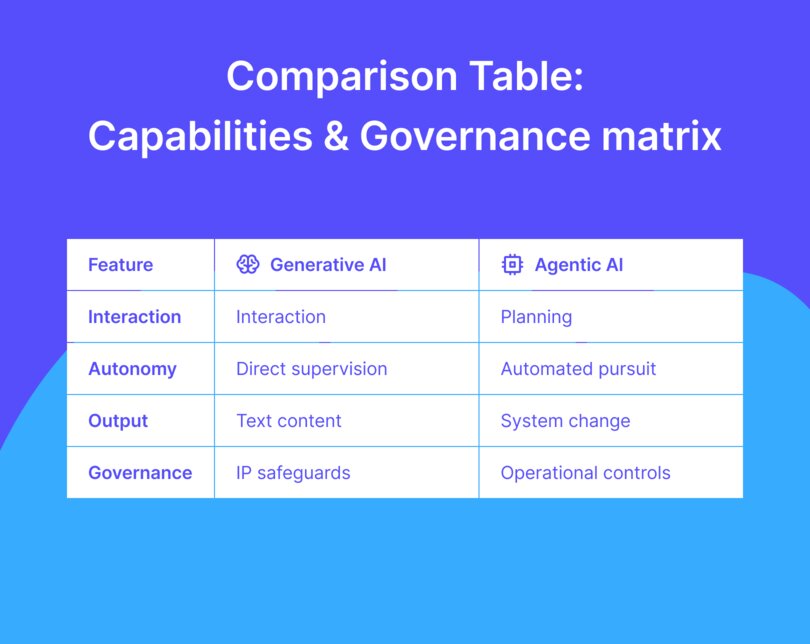
1. Interaction Style
Generative models have responses based on prompts, and agentic systems follow proactive pursuit.
Example: Generative AI writes an email draft after your prompt; agentic AI identifies when an email needs to be sent and schedules follow-ups automatically.
2. Autonomy
While generative tools are human-directed, agentic systems run decision loops with memory.
Example: Generative AI waits for instructions each time; agentic AI remembers past tasks and adjusts plans accordingly without new prompts.
3. Output Type
Generative AI produces content like text and visuals. However, agentic AI produces actions that change system states or trigger workflows.
Example: Generative AI generates a product description; agentic AI updates inventory systems and places restock orders when supplies run low.
4. Governance
GenAI requires content moderation and IP safeguards. On the other hand, agentic AI demands operational controls like audit trails, access management, and liability protocols.
Example: Relevant professionals moderate harmful text from generative AI. But it’s also necessary to have humans track who authorized an automated financial transaction executed by agentic AI.
This matters in real life. After all, according to Gartner, agentic systems will handle about 80 percent of routine customer service by 2029 while cutting operational costs by about thirty percent. Market forecasts and pilots report fast growth and time savings of over sixty percent overall.
How Agentic vs Generative AI Work Under the Hood
Imagine generative AI as a marvelous improv actor who delivers a single brilliant line when cued, who rarely fails to impress its audience. In this case, agentic AI is the project manager who writes the script, books the venue, hires the cast, and makes sure the lights work, but it never waits for you to tell it what to do next.
The architecture of generative models thrives in prompt-response flow. You give them input, they run a statistical prediction to produce text, images, or code, and the job ends there, as they have no persistent memory or long-term strategy. They excel at creative bursts but not sustained execution.
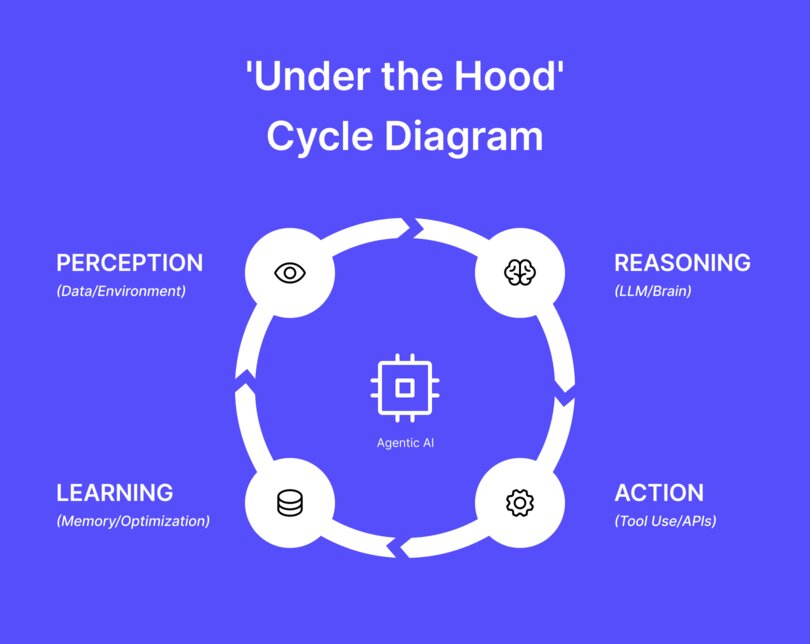
Agentic AI, on the flip side, runs on a collect–reason–act–learn cycle. As such, it can store context, adapt to outcomes, and chain together multiple steps toward an objective. Under the hood, this often involves orchestration frameworks that coordinate tools and APIs, as well as specialized sub-agents. Keep in mind that these agents learn from successes and failures, so they need reinforcement learning to refine decisions over time.
That complexity is paying off. By 2028, one-third of enterprise software will embed agentic AI, up from barely measurable adoption in 2024. Nearly two-thirds of organizations expect over 100% ROI from these systems, and 96% are expanding their use. The market is voting with its budgets, and it is betting on autonomy.
Generative AI vs Agentic AI in Real Life
Is there a better way to understand the difference between generative AI and agentic AI than to watch them in action? That’s when they cease being abstract terms that might overlap and when they can impress you. They can both deliver monumental value, but it’s the context that dictates when they’ll work best, as well as knowing when and which one to use.
Where Generative AI Fits
Generative AI, as we touched on above, is the best technology when you need to instruct AI to create instead of decide. To be more specific, it’s excellent for:
- Content creation: You can draft blog posts, product descriptions, striking graphics, or ad copy. In a nutshell, you can use AI in digital marketing or any creative field.
- Design and imagery: Some of the most common uses are producing product visuals or mockups. This is why generative AI in ecommerce has become such an indispensable asset.
- Code assistance: You can, for example, use AI for WordPress to build plugins, as well as to suggest functions or debug.
Whether you’re a fashion retailer that uses generative AI to produce seasonal campaign copies in three languages with a single click or a designer who needs ideas to nudge their imagination, this technology has a multitude of use cases. And all you need to get content out are effective prompts, as you don’t have to invest time in planning.
What About Agentic AI?
Execution should be as paramount as creation. To achieve that harmony, you’ll need agentic AI. These systems are great for straightforward output results, but they also analyze, diagnose, set different kinds of goals, make decisions, and adapt to changing conditions, regardless of how insignificant or extreme. In real life, this means:
- Automated workflows: You can handle customer support tickets from start to finish.
- Logistics: Reassigning delivery routes in real time based on traffic or weather will be no issue with agentic AI.
- Trading: Executing multi-step strategies in quite volatile markets is something agentic AI makes easier than you’d ever think.
For example, if you owned a logistics firm, you could cut route planning from five hours to under forty minutes with an agentic system that predicts bottlenecks and reallocates resources. Of course, it would do so automatically.
Agentic AI vs Generative AI and the Business Bottom Line
No matter how we feel about generative AI, we’ve already seen that it can speed up creative and technical work. Development teams that use code-generation tools report shipping features around 30% faster. Meanwhile, marketing teams cut content production timelines from weeks to days, which is a striking difference.
And while we can’t deny that those gains are real, they’re still tied to human supervision.
Agentic AI flips this equation by removing the need for constant human orchestration. In enterprise support, autonomous agents that resolve tickets without escalation can dramatically drop per-incident handling costs.
For customer service, this translates into a swift resolution process that will likely continue to improve.
However, the strategic impact is bigger than just “faster and cheaper.” CIOs are about to start treating agentic AI as an invisible member of the workforce. In practice, this means they will likely monitor its output and allocate tasks. Perhaps, CIOs might even measure “agent performance” alongside human KPIs, turning AI into a managed asset.
When it comes to agentic AI vs. generative AI, the latter resembles collaborating with a skillful freelancer who delivers great drafts.
The former is like onboarding a capable employee who takes a project from kickoff to delivery and flags risks, while looping you in only when it matters. You can work with both and redesign how work gets done, as long as you use their differences to your advantage.
What Happens When Agentic AI and Generative AI Join Forces
Ideally, a system will know what to do while also being capable of saying, showing, and shipping it. That way, AI truly becomes a helpful partner that takes the pressure off and does the unnecessary work for you.
Combine agentic AI and generative AI, and that’s what you’ll get.
For example, an agentic AI could coordinate a sprint backlog in software delivery and assign tickets, all while monitoring build pipelines. When AI detects a documentation gap, it can call a generative model to create API docs or onboarding tutorials instantly. Meanwhile, the flow remains intact. The same pattern applies to AI in web design and development, where an agentic AI could manage project timelines or integrate assets. But it could also invoke a generative model to produce responsive layouts or placeholder copy without interrupting deployment.
Even in logistics, the combination can do wonders. Just imagine that an unexpected storm happens, but you can rely on an agentic AI to replan routes. Then, it would use a generative model to draft automated driver instructions and updated customer notifications that read like they were written by a human dispatcher.
The simple way to put it is that generative AI fills in the creative, communicative, and design gaps, but agentic AI makes sure the output happens in the right place and at the right time. And for all of this to happen, you won’t need anyone to babysit the process.
The Risky Bits of Agentic vs Generative AI
No matter how good and promising, every technology comes with risks.
1. Security Blind Spots
Generative AI risks leaking sensitive data through careless prompt design. Agentic AI raises the stakes, as its autonomous actions demand zero-trust frameworks, strict access controls, and immutable audit trails. Without these, a single compromised agent could trigger a chain of system-wide errors.
2. Compliance Under Pressure
As you might assume, compliance risks are mostly content-level in regulated industries concerning genAI. However, agentic AI adds operational compliance, meaning every automated action must meet policy and legal standards, and it must do so as it unfolds.
3. Ethical Accountability
Liability for biased or harmful outputs is murky with generative models. On the other hand, accountability extends to decisions and actions with agentic AI, so precise ownership and escalation paths are a must.
4. Skills and Workforce Impact
Generative AI has a great impact on creative workflows, but agentic AI can genuinely redefine job roles entirely. The caveat is that you need proactive reskilling strategies to fill gaps, but also to prevent “automation surprises” where teams can’t intervene when the system goes off-script.
How to Gauge Your Agentic and Generative AI Maturity
Is your business ready to deploy agentic AI? Where does it stand regarding generative AI? Use the following strategies to find out.
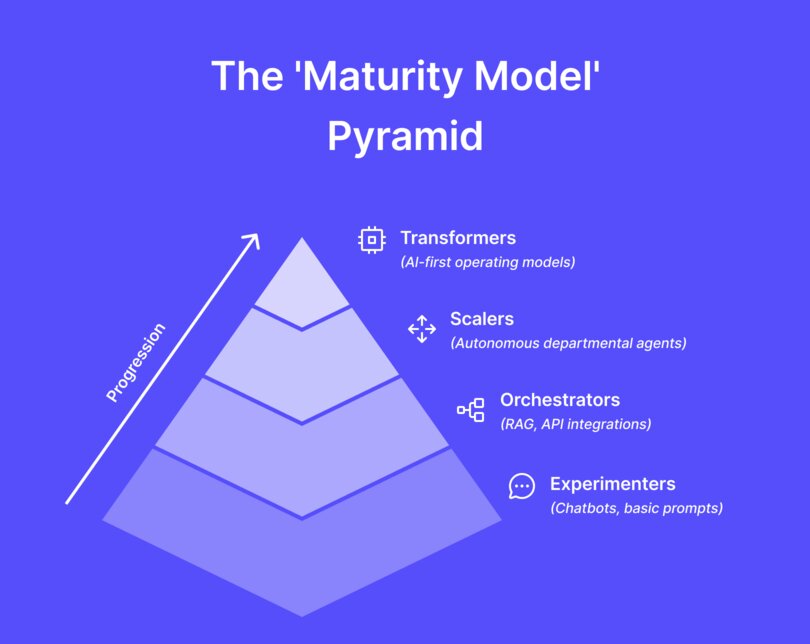
Stage One: Experimenters
Most organizations try their hand at genAI by tackling isolated tasks. For instance, you can use it for content drafting or prototype generation. But keep in mind that the focus is proof of concept rather than scale.
Stage Two: Orchestrators
This is where teams begin combining models with workflows. So, your map might process or enforce governance and pilot agentic systems on low-risk tasks.
If you want to explore how to integrate AI into an app, this stage is your best bet to embed agentic triggers that call generative modules for context-aware outputs.
Stage Three: Scalers
At this point, agentic AI handles multi-step operations with minimal oversight, and generative AI contributes dynamically within these loops. Meanwhile, deployment roadmaps start to target critical business processes.
Stage Four: Transformers
Once you embed AI in the operating model, and it begins to influence strategy as much as execution, you’ve reached AI maturity. Finally, agentic and generative capabilities work smoothly in tandem, and solid compliance, security, and ethical frameworks back them up.
In a nutshell, this is the stage where you’ve adopted new technology, and the next step is organizational adaptability.
Conclusion
Right now, agentic AI vs. generative AI feels like a clean split, but if history has taught us anything, it’s that boundaries in technology rarely hold for long. Their capabilities will inevitably bleed into each other, so rigid definitions risk aging faster than the software itself.
That’s why professional AI development services are about steering where the tools advance, not just adopting them. The “vs.” may vanish, and only the adaptable will progress alongside the technology.