For most of us, buying something from a brand is fairly simple: you browse the web for products, do your research, find the one that meets your criteria the most, you click “buy,” wait for it to arrive, and that’s that. Sometimes, even marketers are guilty of thinking in these simple terms, undermining the importance of the customer experience post-purchase.
The truth is, post-purchase customer engagement can go a long way in transforming reluctant one-time buyers into regulars, or even brand ambassadors. From customer loyalty programs to personalized communication, there are several strategies you can implement to make a purchase experience last longer than placing an order and its arrival.
Redefining the Post-Purchase Customer Experience
Great post-purchase customer service is more than just resolving issues. The way you handle your customers after they’ve bought your product can be a key differentiator for your brand and can help establish deeper connections between your audience and your business.
The customer journey has greatly evolved in the past two decades. While branding became a “thing” in the sixties, digital marketing made branding into a more comprehensive tool that can help boost visibility, create two-sided communication channels, popularize storytelling, and build more momentum with user-generated content.
These changes have led us into an era where marketing is driven by data and where brands can perfect every aspect of their customer relations. With such razor-sharp customer journey strategies, brands can boost customer lifetime value and reduce WISMO rates or keep them optimal (around 21% of all customer queries).
Improving CX: Mapping The Post-Purchase Journey
How to encourage repeat business? Brands would often jump into extensive social media campaigns and email marketing strategies to improve customer experiences, without actually understanding where these people come into contact with their products in the first place.
In order to create great post-purchase experiences, businesses must know the customer journey and understand which touchpoints are the main revenue drivers.
This allows you to set up supporting campaigns that will strengthen your post-purchase experience. Whether you want to upsell, cross-sell, convince shoppers to subscribe, or refer your brand to friends, it’s vital to use the channels that will drive the most engagement.
These can be anything, from emails to online product registration or SMS messages. You can even invite them to your social media community, where they can gain a more organic perspective into how your brand works, who your other customers are, and how you handle different queries.
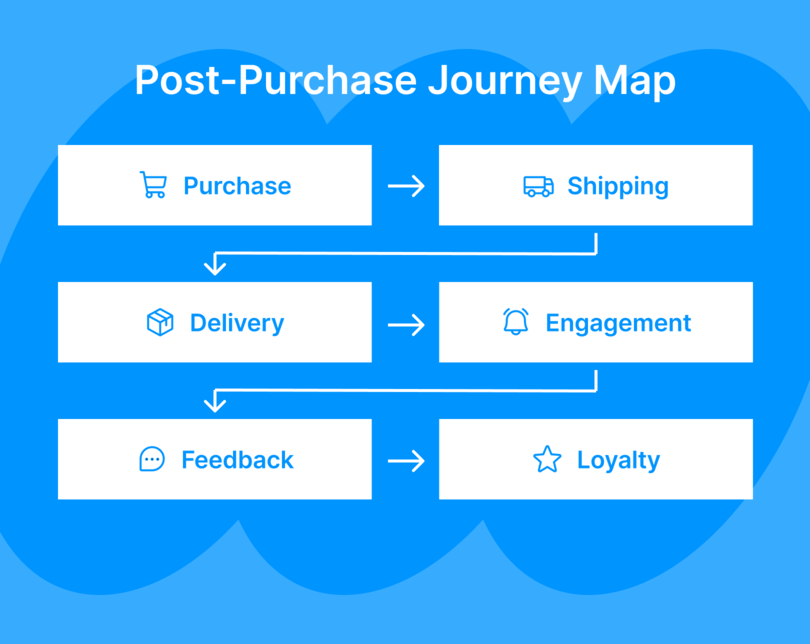
Shipping Should be a Brand Moment
Delivery anxiety is a thing. Often, it has nothing to do with your brand, but with the logistics and warehousing companies that ship and deliver your products. However, sometimes you can’t even blame them for things such as traffic jams or other transportation errors that can arise.
While these things happen, it doesn’t mean that you shouldn’t do something about it. You can go beyond generic updates and create personalized tracking notifications and branded tracking pages.
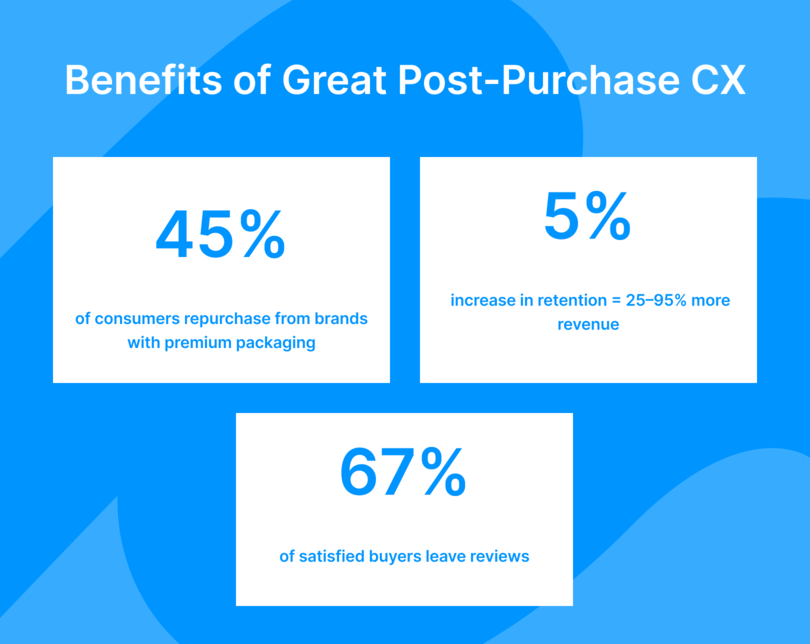
Even though some shoppers hate waiting for delivery, they all look forward to receiving their packages. Make the most out of the anticipation and offer a memorable unboxing experience. Data shows that 45% of consumers are more likely to purchase from brands with premium packaging, and 65% of them say they will likely share the image of the package on social channels if it’s unique and gift-like.
Be Proactive, Everywhere
Post-purchase customer support should be an omnichannel endeavor, just like your marketing. Ensuring that customers can engage with your brand on all post-purchase touchpoints (like SMS, email, social media, or live chat), you can perfect post-purchase service and address queries and slight inconveniences before they become problems.
From customer service software platforms to overarching strategies, you need to put the work into creating a post-purchase experience in which your buyers truly feel heard and valued.
For example, Warby Parker rewrote the rule book of buying glasses online by offering customers the chance to try five frames at home as a part of their Home Try-On program and easy returns. They also went one step further, offering personalized guidance from stylists, which managed to boost purchases by 50%. To create an even more immersive customer experience, they encouraged customers to involve their social circles in the frame selection with the #WarbyHomeTryOn hashtag that generated over 50,000 posts.
Personalize
Personalisation has become a decisive driving force in digital marketing. Data from McKinsey shows that around 71% of customers expect personalized interactions from brands.
From segmenting your newsletter email lists to enabling customers to engage with your brand on all surfaces (social channels, WhatsApp, email, or your website), you can implement various personalization strategies to create more opportunities for meaningful post-purchase engagement, but one of the greatest new ways to address various customer preferences at scale is through AI development services.
For instance, in the case of eCommerce, artificial intelligence can create hyper-personalized recommendations for customers based on previous interactions, chatbots can double as personal shopping assistants, while offering effective analytics to perfect your strategies even further. Even integrating ChatGPT into your current eCommerce infrastructure can help you with basic customer support and ensure that customers have a more profound experience with your brand.
Another way to improve your post-purchase experiences is by actively listening to feedback from your buyers.
Collect Feedback
Prompting shoppers to share their experiences on social media or via email is a vital part of the post-purchase behavior. In fact, in addition to potentially strengthening the bond between the customer and your brand, reviews and testimonials also double as social proof for people who are still considering buying from you.
Reviews can also serve as invaluable feedback. Your product can be flawless, but some buyers may point out that they had problems with shipping. Being on top of user reviews and social community discussions about your products gives you a great opportunity to perfect your offerings and show your customers that you’re listening.
Take Lego Ideas as a great example: it’s a place where brand fans can submit their unique ideas to the company, and the rest of the community votes on each creation. The concept with the most votes even has a chance to become the next official Lego set.
Create a Robust Loyalty Program
Customer loyalty equals ongoing and stable revenue. Even older data suggests that loyal customers spend 67% more on products and services, and that a 5% increase in customer retention can lead to a revenue increase between 25% and 95%.
Creating a comprehensive loyalty program can greatly improve your post-purchase experience efforts; however, you must avoid the common pitfalls associated with these programs. More specifically, you need to have realistic expectations for your programs, communicate them effectively with your customer base, and have them be highly individualized to cater to the actual needs of individual buyers.
In addition to a great referral program, offer tiered benefits, surprise perks, and value-driven strategies (like community access and webinar invites). The goal is to truly offer value. A great example of this would be Starbucks and its gamified loyalty program, using blockchain-based rewards. In other words, customers have the chance to earn NFT collectibles and access VIP perks, combining digital and real-world benefits. By using Starbucks Odyssey, program members face gamified challenges and learn about the brand’s story while earning digital collectibles.
The brand also implemented augmented reality into its mobile app, which allows users to scan in-store codes and unlock new rewards, exclusive tasting events, early product launches, and merchandise.
Implement an Impeccable Return/Refund System
While you probably don’t want your customers to return the goods they’ve bought from you, it’s an inevitable part of modern commerce, and thus, a quintessential part of the entire post-purchase experience, and another opportunity to make a good impression.
As such, start the return experience even before the customer asks for it.
- Make your return policy easily accessible and displayed prominently, stating all return conditions like time frames, restocking fees, and eligible items.
- Opt for self-service returns so that customers can initiate the process without having to contact someone from customer support.
- Encourage exchanges and offer them instead of refunds. To make the incentive even more irresistible, offer bonus credits or free return shipping.
- Offer free return shipping with prepaid shipping labels to simplify the return process, while demonstrating that you are committed to customer satisfaction.
- Provide customers with several return options.
- Engage with customers during the return process, enable them to track their return and/or exchange delivery.
- Follow up after the return process is complete.
Offer Great Customer Service to Begin With
In order to make the post-purchase journey something your buyers want to experience repeatedly, you need to encourage them to buy in the first place. The initial service is the first step toward retention; it sparks referrals and builds a reputation.
Outstanding customer service isn’t only reserved for up-and-coming brands. Even the most exclusive ones should uphold the highest standards and should treat their customers with nothing but respect. For instance, a lot of people raised their voice against how Ferrari treats its buyers and how the brand “lets” them buy cars. This attitude may be reminiscent of how company founder Enzo Ferrari treated his customers in the early days (which ultimately led to the creation of the prancing horse’s biggest Italian rival, Lamborghini).
Even avid car collector and TV personality Jay Leno has shared his views of never wanting to own a Ferrari, despite thinking they are great machines. He also dislikes the brand’s and dealer’s attitudes toward customers. On the other hand, he highlighted how the British supercar brand, McLaren, and German Porsche have terrific customer service.
Optimize The Entire Customer Journey
When done well, a good post-purchase strategy can help you boost key metrics, such as:
- Customer Lifetime Value: LTV stands for the cumulative total of a single customer’s purchases. When customer post-purchase experiences are great overall, your brand encourages repeat purchases, driving up LTV.
- More Verified Product Reviews:. Around 67% of satisfied customers will consider leaving a review. If you are offering a great product with impeccable support and ask for a review after the purchase, chances are, you’re going to end up with more genuine reviews.
- Diversified Traffic: While you do have control over paid and organic traffic, it can be difficult to influence them directly and make massive changes overnight. However, by optimizing the customer journey, you can incentivize repeat purchases and, through it, see growth in referral accounts, direct, and email traffic categories.
- Better Conversion Rates: Verified reviews and repeat purchases should also boost your overall conversion rates.
And while seeing these improvements may tempt you to stop optimizing traditional conversion rates, it is far from that. Don’t forget that the post-purchase experience is only a part of the overall customer journey. Optimizing the entire journey is an ongoing process and spans from the first branded exposure to every repeat purchase ever made.
As such, optimizing the customer journey should start with pre-purchase. Just as we mentioned above, providing great customer service should be your ultimate goal, and that doesn’t start with returns or asking for reviews.
Always Look at the Bigger Picture
While these post-purchase strategies can help you form stronger bonds between your brand and customers, at some point, they all build on the same thing: great overall customer experiences.
From the exploration period to making the first purchase, brands should focus on providing impeccable service and a strategic, omnichannel approach to marketing and selling. This ensures your customers can always reach out to you when they are ready to buy, and they will have a pleasant experience while doing so.